

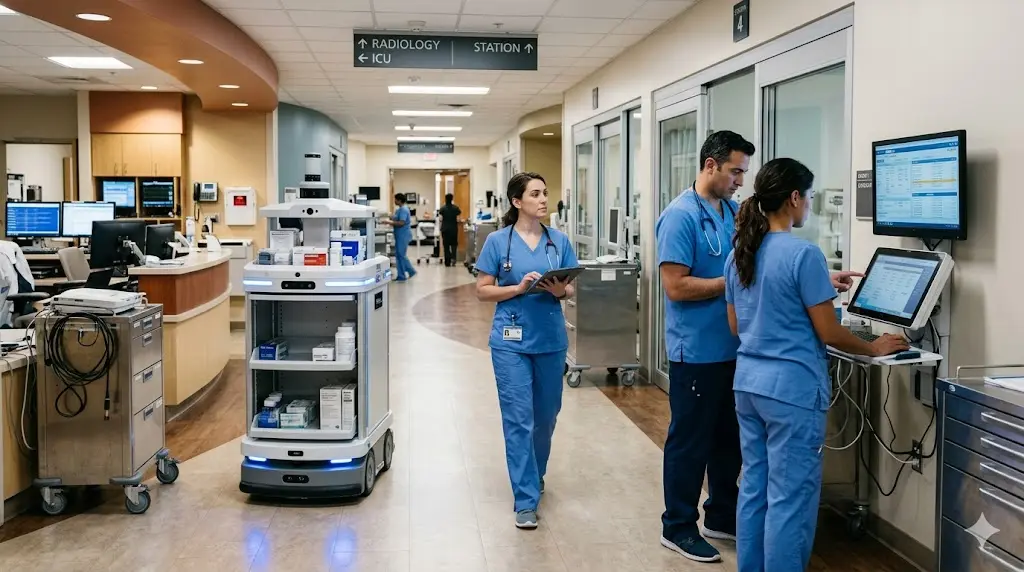
Automation in healthcare is improving speed, diagnostics, and hospital efficiency, but it’s also creating serious concerns around patient trust, medical errors, job security, and data privacy. Many healthcare systems now depend heavily on algorithms and AI-driven tools, yet human judgment still matters more than most people realize.
Healthcare automation is growing rapidly because hospitals want faster operations and lower costs. The concern comes from overdependence on AI systems, reduced human interaction, cybersecurity risks, and the possibility of incorrect medical decisions affecting real patients.
Healthcare professionals, patients, and policymakers are all asking the same question now: how much automation is too much? That question sits at the center of the debate around why automation is a growing concern in healthcare worldwide.
Over the last few years, hospitals have adopted automated scheduling systems, robotic surgeries, AI-powered diagnostics, virtual assistants, and predictive analytics. Some of these tools genuinely help doctors save lives faster. Others create gaps that many patients don’t even notice until something goes wrong.
Here’s the thing. Technology in medicine isn’t automatically bad. In fact, some automated systems are extremely accurate. But when healthcare organizations rush implementation without proper oversight, problems appear fast.
What Is Healthcare Automation?
Healthcare Automation: The use of software, artificial intelligence, robotics, and digital systems to perform medical or administrative tasks with minimal human involvement.
Automation can appear in several forms:
AI tools analyzing scans
Chatbots handling patient queries
Robotic-assisted surgery
Automated billing systems
Electronic health record management
Predictive healthcare analytics
In most cases, automation exists to reduce workload and improve efficiency. Hospitals dealing with staff shortages often see automation as a practical solution.
Still, patients don’t always want a machine making decisions about their health.
That emotional concern matters more than many tech companies admit.
Why Automation Is a Growing Concern in Healthcare Worldwide in 2026
Healthcare automation concerns have intensified in 2026 because adoption is accelerating faster than regulation. Many systems now rely on AI-supported decision-making before governments fully establish accountability standards.
One major issue is trust.
Imagine receiving a serious diagnosis generated mainly through an automated screening tool. Even if the diagnosis is correct, many patients still want reassurance from a real doctor. Human empathy can’t really be automated, at least not convincingly.
Another growing concern is algorithm bias. AI systems learn from existing medical data. If that data contains historical inequalities or incomplete demographic representation, the technology may produce unfair or inaccurate outcomes.
A study referenced by World Health Organization has repeatedly highlighted the importance of ethical AI use in healthcare systems. Concerns around fairness, transparency, and patient safety continue to grow globally.
What most people overlook is that automation errors scale very quickly. A human mistake may affect one patient. A flawed algorithm can affect thousands before anyone notices.
That’s a massive difference.
Expert Tip
Hospitals adopting AI healthcare systems should never remove human review layers completely. Automation works best as assistance, not replacement. In my experience, the safest healthcare environments use technology to support clinicians rather than override them.
How Healthcare Automation Works Step by Step
Understanding the process helps explain why automation can become risky when implemented poorly.
1. Data Collection
Hospitals collect patient records, test results, scans, prescriptions, and medical histories. AI systems use this information for analysis.
If the input data is inaccurate, the output may also be flawed.
2. Algorithm Processing
Machine learning systems identify patterns and make predictions. For example, AI may flag possible heart disease risks based on previous patient data.
This sounds efficient. Sometimes it really is.
But predictive healthcare analytics can still misinterpret unusual cases.
3. Automated Recommendations
The system generates suggestions for treatment plans, diagnoses, or scheduling decisions.
Doctors may review these suggestions, though some clinics are beginning to depend heavily on automation.
4. Human Review
Ideally, medical professionals verify recommendations before action is taken.
Unfortunately, understaffed hospitals occasionally rely too much on automated outputs.
5. Continuous Learning
AI systems improve through additional data over time. That creates efficiency but also introduces evolving risks if oversight remains weak.
Why Patients Feel Uneasy About Automated Healthcare
Many healthcare concerns aren’t purely technical. They’re emotional too.
Patients want empathy, reassurance, eye contact, and human understanding during vulnerable moments. Automation struggles with that.
I’ve seen healthcare apps answer patient questions with technically correct responses that still felt cold and dismissive. That disconnect matters more than developers probably expect.
A patient dealing with cancer anxiety doesn’t just need information. They need emotional confidence.
Healthcare isn’t customer support. That’s the counterintuitive point many automation advocates miss.
Real-World Example
A large hospital network introduced automated symptom-checking kiosks to reduce waiting times. Initially, the system improved efficiency dramatically. Then complaints started appearing.
Older patients struggled with the interface. Some misunderstood questions. Others felt uncomfortable sharing sensitive medical details with a screen rather than a person.
Efficiency improved on paper. Patient satisfaction dropped sharply.
That happens more often than hospitals publicly discuss.
Can AI Replace Doctors Completely?
Short answer: probably not.
AI can assist diagnostics, process data faster, and reduce repetitive tasks. But medicine involves judgment, ethics, communication, intuition, and contextual understanding that machines still can’t fully replicate.
Here’s another issue people rarely discuss openly: doctors themselves may begin trusting automation too much.
This is called automation bias.
When healthcare professionals assume automated systems are always correct, they may overlook obvious errors. That can become dangerous quickly.
According to research discussed by National Institutes of Health, maintaining human oversight remains one of the most important safety principles in medical AI deployment.
Expert Tip
Healthcare providers should train staff to challenge automated recommendations instead of accepting them automatically. Healthy skepticism actually improves patient safety in AI-supported environments.
The Employment Problem Nobody Wants to Talk About
Automation anxiety among healthcare workers is very real.
Administrative staff, billing teams, transcription workers, and even some diagnostic specialists increasingly worry about job displacement.
Hospitals argue automation helps reduce burnout. Sometimes that’s true. Yet workers also fear becoming dependent on systems they don’t fully control.
In my opinion, the biggest long-term problem isn’t total job loss. It’s skill erosion.
If clinicians rely heavily on automated recommendations for years, independent critical thinking might weaken over time. That’s not hypothetical anymore. Some medical educators are already raising concerns about overdependence on AI-assisted learning tools.
Are Healthcare Data Privacy Risks Increasing?
Absolutely.
Healthcare automation depends heavily on patient data. That makes hospitals attractive targets for cybercriminals.
Medical records contain extremely sensitive information including prescriptions, diagnoses, insurance details, and personal identification data.
One cybersecurity breach can expose millions of records.
Healthcare providers now face pressure to balance innovation with data protection. Unfortunately, many smaller clinics adopt digital systems faster than they improve security infrastructure.
That gap creates vulnerability.
Mini Case Study
A regional healthcare provider implemented cloud-based automation tools to improve patient scheduling and diagnostics. Operations became faster within months. Then a ransomware attack temporarily shut down access to patient records.
Appointments were delayed. Emergency departments experienced confusion. Trust suffered immediately.
The technology itself wasn’t necessarily the problem. Weak security preparation was.
What Actually Works When Introducing Healthcare Automation?
Balanced implementation works best.
Organizations seeing positive results usually follow a few practical principles:
Keep doctors involved in final decisions
Test algorithms across diverse populations
Train employees continuously
Prioritize cybersecurity early
Introduce automation gradually rather than all at once
Let me be direct. Hospitals that chase automation purely to cut costs often create larger problems later.
Healthcare technology should improve patient care first. Efficiency should come second.
That order matters.
Expert Tip
Before adopting new healthcare AI systems, organizations should measure patient trust alongside operational performance. Faster service means very little if patients stop feeling safe or heard.
What Does the Future of Healthcare Automation Look Like?
Automation in healthcare will continue expanding. That part is almost certain.
AI-assisted surgery, remote diagnostics, predictive analytics, and personalized treatment systems are already becoming more common worldwide. The challenge is making sure human-centered care doesn’t disappear in the process.
Some experts believe the future model will combine AI efficiency with stronger physician oversight. Others worry cost pressures may push hospitals toward excessive automation.
Honestly, both outcomes seem possible right now.
Healthcare systems that maintain transparency and patient trust will probably adapt best over the next decade.
People Most Asked About Why Automation Is a Growing Concern in Healthcare Worldwide
Why are people worried about automation in healthcare?
People worry automation may reduce human interaction, increase diagnostic errors, threaten jobs, and create privacy risks. Many patients still prefer human medical judgment over machine-generated recommendations.
Can automation improve healthcare quality?
Yes, in many cases it can. Automated systems often improve speed, accuracy, and administrative efficiency. Problems usually appear when organizations rely too heavily on automation without proper oversight.
Is AI more accurate than doctors?
AI can outperform humans in certain data-heavy tasks like image recognition or pattern analysis. Still, doctors provide contextual understanding and emotional intelligence that AI currently lacks.
Will healthcare workers lose jobs because of automation?
Some administrative roles may decline over time. However, most healthcare experts believe automation will change jobs more than completely eliminate them.
Are automated healthcare systems safe?
They can be safe when properly tested and monitored. Risks increase when systems lack transparency, security protections, or human review processes.
Why does human interaction still matter in medicine?
Patients often need empathy, reassurance, and nuanced communication during treatment. Machines can provide information, but emotional care still depends heavily on human connection.
Healthcare organizations looking to improve digital visibility can also benefit from services offered by digital marketing services and press release distribution services. These platforms help businesses, startups, agencies, and SEO professionals strengthen brand visibility, gain high authority backlinks, improve SEO ranking, and drive organic traffic through instant publishing and broader media coverage.