

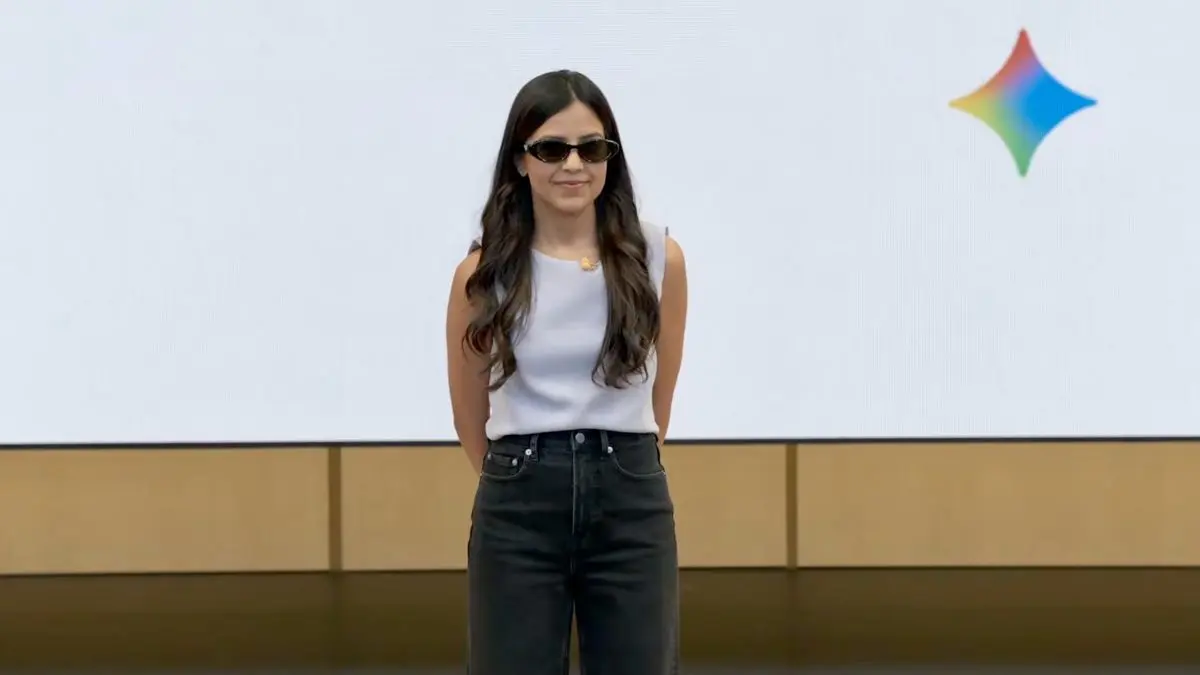
For years, smart glasses have existed in a kind of aesthetic purgatory: too techy for fashion people, too awkward for mainstream consumers, and often associated with the exact kind of guy who makes everyone in the coffee shop (or Pilates class) extremely uncomfortable. Even when tech bros promised that smart eyewear represented the future, the frames themselves rarely looked like something anyone actually wanted to wear outside a product demo.
That's why Google and Samsung's new collaboration with South Korean luxury eyewear label Gentle Monster feels notable. More than a tech announcement, the partnership signals a broader shift in how Silicon Valley is approaching wearable AI: by finally admitting that people care what these things look like.
Unveiled during Google I/O 2026, the collaboration marks the first public reveal of Google's Android XR smart glasses developed with Gentle Monster and Samsung. The glasses, arriving later this year, will feature built-in speakers, microphones, and a camera, allowing wearers to listen to music, take calls, snap photos, and interact with Google's Gemini AI assistant hands-free. But the actual technology almost feels secondary to the pitch: these are smart glasses designed to be stylish first.
Unlike earlier attempts at wearable tech, they actually look fashionable. The slim oval-shaped black frames and narrow tinted lenses lean fully into Gentle Monster's signature aesthetic: sleek, slightly futuristic, and unmistakably fashion-forward. Instead of looking like conspicuous gadgets, the glasses resemble the kind of Y2K-inspired eyewear already dominating runways, K-pop airport photos, and downtown street style. They feel less like a Silicon Valley prototype and more like a cool girl accessory. Expect celebrities and creators to start styling these immediately.
Pricing remains a mystery, though given Gentle Monster's positioning in the luxury market, these likely won't be impulse-buy territory. The brand's regular eyewear already tends to hover between roughly $250 and $400, with some statement styles climbing even higher. Industry analysts suggest the smart glasses could cost upwards of $500, reflecting both the technology and the designer label premium.
"We believe that for intelligent eyewear to become part of people's daily lives, it first must be great eyewear," Juston Payne, senior director of product management for Android XR at Google, explained to fashion trade WWD. "Eyewear is very personal — it is part of how people project who they are to the world." That sentiment represents a major departure from earlier generations of wearable tech, which often prioritized utility over aesthetics.
A brief history of smart glasses failures
Products like Google Glass became cultural punchlines partly because they looked alienating and conspicuously futuristic. Wearing them announced not just that you liked technology, but that you wanted everyone else to know it. The original Google Glass Explorer Edition, released in 2013, featured a bulky frame with a prominent display prism that screamed "I'm wearing a computer." Privacy concerns mounted as wearers could discreetly record video, leading to bans in bars, casinos, and movie theaters. The device was widely mocked as a solution in search of a problem, and Google quietly discontinued it for consumers in 2015.
Other attempts followed similar trajectories. Snap's Spectacles launched with great fanfare in 2016, marketed as a fun way to capture memories from a first-person perspective. The initial run was a gimmick success, but sales quickly fizzled as the novelty wore off. The Spectacles were round and colorful but still looked like a gadget, not a fashion statement. Snap later pivoted to augmented reality offerings, but mainstream adoption remains limited.
Meta took a different approach by partnering with Ray-Ban, a brand with decades of cultural cachet. The Ray-Ban Meta smart glasses, launched in 2023 and updated in 2024, embed cameras, speakers, and AI into classic Wayfarer and Skyler silhouettes. They sold better than expected, with Meta reporting over 2 million units shipped, but still represent a tiny fraction of the global eyewear market. The key lesson was clear: familiar shapes help, but genuine style credibility matters even more.
Why Gentle Monster changes the equation
Gentle Monster's involvement elevates the fashion quotient significantly. Founded in 2011 in Seoul, the brand quickly became known for its avant-garde designs, oversized frames, and futuristic flourishes. Unlike Ray-Ban, which is a heritage brand rooted in mid-century American cool, Gentle Monster is purely contemporary, equally at home on K-pop idols and high-fashion runways. The brand's flagship stores in Seoul, New York, and Shanghai are immersive art spaces featuring rotating installations by sculptors and digital artists, reinforcing its identity as a lifestyle brand rather than just an eyewear maker.
The crossover appeal of Gentle Monster cannot be overstated. Celebrities like BLACKPINK's Jennie, Stray Kids' Felix, and Hollywood stars such as Jennie Kim and Chloë Sevigny have been photographed wearing its frames. The brand operates at the intersection of art, technology, and streetwear, which is precisely the sweet spot that smart glasses need to occupy. By partnering with Gentle Monster, Google and Samsung are signaling that they understand fashion is not an afterthought but a core product attribute.
"Google clearly understands what Gentle Monster brings to the table," Payne said. "We have admired Gentle Monster's work for many years, praising the brand's 'iconoclastic approach' and ability to create emotional experiences around eyewear." That emotional connection may be the missing ingredient smart glasses have needed all along. Consumers were never going to embrace AI eyewear if the frames made them feel self-conscious.
The design details reflect this philosophy. The Android XR glasses are slim, with a metal bridge and subtle hinge accents that blend into the frame. The camera module, typically a dead giveaway for smart glasses, is integrated almost invisibly into the temple. There are no visible lenses for augmented reality or displays; instead, the glasses rely on voice commands and a button on the temple to capture photos or videos. This minimalist approach ensures the glasses don't scream "tech gadget," allowing them to pass as regular high-end eyewear.
Tech specs and capabilities
Under the hood, the glasses run Android XR, Google's new operating system for extended reality devices. They are powered by Samsung's Exynos chipset, with a dedicated AI processor for on-device Gemini interactions. The built-in speakers use directional audio to keep sound private, while the microphones are beamforming for clear voice pickups even in noisy environments. The camera captures 12-megapixel photos and 1080p video, with software stabilization to reduce shakiness. Storage is rumored to be 64GB, enough for thousands of photos and hours of clips.
Integration with Gemini allows wearers to ask questions about what they see, get real-time translations, summarize documents, or set reminders without pulling out a phone. Google has emphasized that the glasses work alongside smartphones rather than replacing them, addressing a key concern from the Google Glass era. Notifications are sent via audio prompts, and users can respond with voice commands or tap gestures on the frame.
Battery life remains a challenge for all smart glasses, and here Google claims around 8 hours of mixed use with the included charging case. The case itself provides three additional full charges, making the setup viable for all-day wear. Wireless charging is supported, and the glasses feature IPX4 water resistance for sweat and light rain.
Privacy features include a physical camera cover and a visible LED indicator when recording. Google has stated that video recordings will include an audible chime, but critics note that the chime can be disabled in software settings, potentially raising concerns about surreptitious recording. These are exactly the kinds of issues that previous smart glasses have struggled with, and Google will need to navigate them carefully to avoid repeating past mistakes.
Compared to Meta's Ray-Ban glasses, the Gentle Monster collaboration is notably more fashion-forward. Meta's glasses, while successful, are still essentially Ray-Ban frames with tech inside — they don't push design boundaries. Gentle Monster's frames are more sculptural and avant-garde, appealing to consumers who see eyewear as a defining accessory. This could broaden the smart glasses market beyond early adopters and tech enthusiasts to include fashion-conscious consumers, a demographic that has largely ignored the category.
Industry analysts are cautiously optimistic. "The partnership with Gentle Monster is a smart move by Google," said wearable tech analyst Maribel Lopez. "Fashion has always been the gatekeeper for wearables. If it doesn't look good, it won't sell, no matter how powerful the technology is. By working with a brand that has genuine cultural currency, Google is giving itself the best possible chance to break through."
Yet challenges remain. The price point, expected to be $500 or more, will limit adoption to early adopters and fashion enthusiasts. And the smart glasses category as a whole faces skepticism from privacy advocates and consumers wary of always-on cameras. Google has tried to address these concerns by promising on-device processing to minimize data sent to the cloud, but scrutiny will be intense.
The broader context is that wearable AI is moving from niche gadgets to mainstream lifestyle accessories. Smart glasses are being marketed not as replacements for smartphones but as seamless extensions of existing digital habits. Google says Gemini will work alongside users' phones and apps, allowing wearers to interact with information while remaining visually engaged with the world around them. But functionality alone won't sell this category. Style will.
For perhaps the first time, tech companies understand that the future of wearable AI may depend less on convincing people that smart glasses are useful, and more on convincing people they look cool. The catch is that the more invisible and stylish the technology becomes, the easier it may be to overlook the privacy concerns built into it. As Google and Samsung prepare to ship these glasses later this year, the question remains: will consumers embrace them as the ultimate fashion-tech accessory, or will they become another footnote in the long, rocky history of smart eyewear? The answer likely hinges on whether Gentle Monster's cool factor can overcome the deep-seated discomfort that many people still feel about wearing a computer on their face.
Source: Mashable India News