

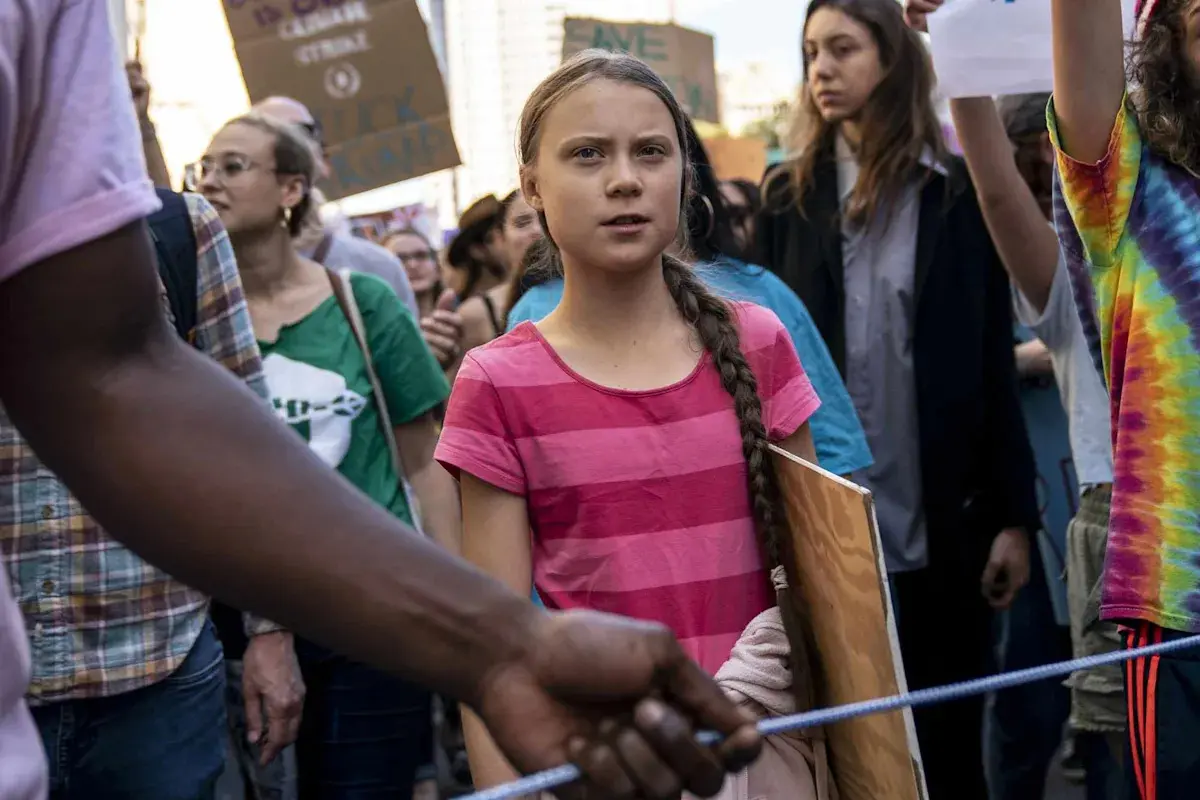
Greta Thunberg was only 15 years old when she ignited a global movement that would reshape the conversation around climate change. In August 2018, the Swedish teenager began a solo school strike outside the Riksdag (the Swedish parliament) in Stockholm, holding a hand-painted sign that read 'Skolstrejk för klimatet' (School Strike for Climate). Her simple act of defiance captured the world's attention and quickly grew into an international phenomenon known as Fridays for Future.
Thunberg's activism was born out of a deep concern for the planet that she says began when she was just eight or nine years old. In her book 'I Know This to Be True: Greta Thunberg,' she recalled learning about environmental destruction and climate change in school and feeling bewildered that adults were not taking more urgent action. 'I just couldn’t understand how we could just continue not caring about this,' she said. That sense of urgency propelled her to take a stand.
The Spark That Lit a Fire
In the weeks leading up to the Swedish general election in September 2018, Thunberg skipped school every day to protest outside parliament. After the election, she continued striking every Friday, posting about her actions on social media. The hashtag FridaysForFuture went viral, inspiring students around the world to walk out of their classrooms and demand climate action. By February 2019, nearly 10,000 students in the United Kingdom alone had participated in protests, according to The Guardian. The movement spread to over 150 countries, with millions of young people taking to the streets.
Thunberg's message was clear and uncompromising: world leaders were failing young people by not addressing the climate crisis with the seriousness it deserved. In December 2018, she addressed the United Nations COP24 Climate Summit in Poland, where she told leaders, 'You are not mature enough to tell it like it is. Even that burden you leave to us children.' Her speech drew widespread acclaim and set the tone for her future activism.
Speaking Truth to Power at the United Nations
Perhaps her most famous moment came in September 2019 at the U.N. Climate Action Summit in New York City. Thunberg, then 16, delivered a passionate speech that was both raw and accusatory. She said, 'You have stolen my dreams and my childhood with your empty words. ... We are in the beginning of a mass extinction, and all you can talk about is money and fairy tales of eternal economic growth. How dare you!' The speech resonated around the world and became a rallying cry for climate activists everywhere.
That same year, she traveled across the Atlantic Ocean by sailboat — a two-week zero-emissions voyage — to attend the summit and meet with U.S. lawmakers. She chose to sail rather than fly to avoid the carbon footprint of air travel, making a powerful statement about the need for personal and systemic change. Upon arriving in New York City on August 28, 2019, she told CBS News, 'It is insane that a 16-year-old would have to cross the Atlantic Ocean to make a stand.'
Recognition and Awards
Thunberg's impact did not go unnoticed. In March 2019, she was nominated for the Nobel Peace Prize for her climate advocacy. Although she did not win that year — the prize went to Ethiopian Prime Minister Abiy Ahmed Ali — the nomination highlighted her influence. In July 2020, she won the Gulbenkian Prize for Humanity, awarded €1 million (about $1.15 million), which she donated to organizations fighting climate change and the COVID-19 pandemic. Later that year, she was named TIME's Person of the Year, becoming the youngest person ever to receive the honor. Former TIME editor-in-chief Edward Felsenthal said, 'She became the biggest voice on the biggest issue facing the planet this year.'
Living with Asperger's: A Superpower
Thunberg has been open about her Asperger's syndrome diagnosis, which she describes as a 'superpower.' In a tweet from August 2019, she wrote, 'I have Aspergers and that means I’m sometimes a bit different from the norm. And – given the right circumstances- being different is a superpower.' She has faced criticism and online harassment because of her condition, but she has turned that negativity into fuel for her activism. In a conversation with PEOPLE in October 2019, she said, 'Being different is a good thing. It’s something we should aspire to be.' Her honesty about neurodiversity has inspired many young people to embrace their own differences.
Books and Continued Advocacy
Thunberg has also become a published author. In 2018, she co-wrote 'Our House Is on Fire: Scenes of a Family and a Planet in Crisis' with her family, detailing their personal struggles and the urgency of the climate crisis. In 2019, she released 'No One Is Too Small to Make a Difference,' a collection of her speeches. The following year, 'I Know This to Be True: Greta Thunberg' was published as part of a series of interviews with influential figures. Her most recent book, 'The Climate Book' (2022), became a New York Times bestseller. It features contributions from over 100 experts — scientists, economists, and activists — along with her own insights and stories from the front lines of climate activism.
Recent Activities and Global Impact
As Thunberg has grown older, her activism has evolved. She has continued to lead climate strikes and speaks out against greenwashing by corporations and governments. She has also taken on new causes. Most recently, she set out on an aid boat to Gaza during the Israel-Hamas war, a mission that drew international attention and was subsequently seized by Israeli forces. This move showed her willingness to use her platform for humanitarian issues beyond climate change.
Thunberg's influence extends far beyond her own actions. The Fridays for Future movement has spurred similar protests globally, with young people organizing their own local strikes. In 2019, the Global Climate Strikes saw millions of participants in over 150 countries. Her speeches have been translated into dozens of languages, and she has met with world leaders, including former U.S. President Barack Obama and German Chancellor Angela Merkel. Despite facing intense backlash from critics who dismiss her as a puppet or accuse her of being alarmist, Thunberg remains steadfast. Her determination has inspired a generation to speak up and demand a livable future.
Climate change is a complex issue, but Thunberg's message is straightforward: listen to the science, take immediate action, and hold those in power accountable. She has argued that incremental change is not enough and that the world must undergo a rapid transformation to avoid catastrophic warming. Her uncompromising stance has made her a polarizing figure, but also one of the most effective activists of her time.
The Role of Youth in the Climate Movement
Thunberg is part of a broader wave of young climate activists, including the Sunrise Movement in the United States, the Youth Climate Strike in Australia, and countless local organizers. These young people have brought a new sense of urgency to the climate debate, often using social media to amplify their voices. Thunberg's approach — direct, moral, and impatient — has been particularly effective in capturing media attention and forcing politicians to respond. Her 2019 speech at the U.N. was a defining moment not just for her, but for the entire youth climate movement.
Critics have questioned the effectiveness of school strikes and protests, but research suggests that public pressure can indeed lead to policy changes. In Sweden, for example, the government announced a new climate law in 2019, partly in response to Thunberg's activism. The European Union also declared a climate emergency that year. While it is difficult to attribute these actions solely to Thunberg, her role in raising awareness cannot be underestimated.
Thunberg's journey from a lone protester to a global icon demonstrates the power of individual action to start a movement. Her story continues to inspire new generations of activists who see that even young people can make a difference. As she enters adulthood, her focus remains on the climate crisis, but she has also expanded her advocacy to include issues like racism, inequality, and human rights. She has participated in protests against police brutality and has spoken out in support of Indigenous communities fighting fossil fuel projects.
In an era of information overload and political inertia, Greta Thunberg stands out as a beacon of clarity and conviction. Her legacy is still being written, but one thing is certain: she has already changed the world.
Source: Yahoo News News