

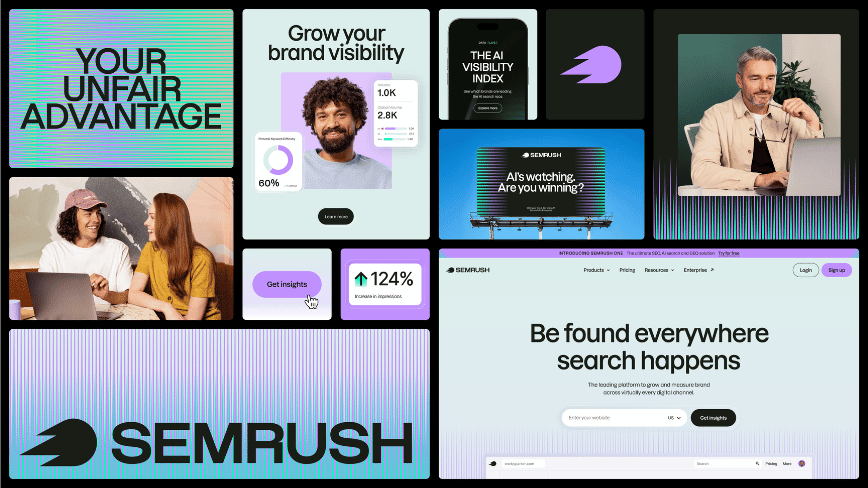
Summary: Semrush has launched a Brand Visibility Framework at Adobe Summit, introducing “Agentic Search Optimisation” as a new method for assessing brand visibility across AI-generated responses, traditional search engines, and autonomous AI agents. This initiative is informed by a dataset of 213 million large language model prompts and comes at a time when organic click-through rates have dramatically decreased.
At the recent Adobe Summit in Las Vegas, Semrush unveiled its Brand Visibility Framework, a strategic model designed to gauge how brands are discovered across various platforms, including traditional search engines, AI-generated answers, and autonomous AI agents. The framework introduces the concept of “Agentic Search Optimisation,” a new operational discipline that leverages over 213 million large language model prompts to provide insights into how brands are being discussed, recommended, or overlooked in environments where traditional clicks are absent.
This launch is timely as Semrush is in the midst of being acquired by Adobe for $1.9 billion, a deal announced in November 2025 and expected to finalize in the coming months. The framework positions Semrush as a crucial visibility layer within Adobe’s marketing ecosystem at a time when the landscape of brand discovery is being transformed by AI technologies.
The Challenge Addressed by the Framework
The data supporting this framework presents a daunting outlook for businesses reliant on organic search traffic. Gartner predicted in February 2024 that traditional search engine activity would decrease by 25% by 2026, primarily due to the influence of AI chatbots and virtual agents. This prediction aligns with current trends, as Google’s AI Overviews are now activated on 48% of all tracked search queries, marking a 58% increase year-over-year, and affecting 80 to 88% of informational queries across various industries. Organic click-through rates have plummeted by 61% for queries that feature AI Overviews, while paid search click-through rates have dropped drastically from approximately 11% to just 3% in a single month last year.
Moreover, zero-click searches, where users receive answers without visiting any websites, have surged from 56% to 69% of all queries from May 2024 to May 2025. ChatGPT has amassed 800 million weekly active users, and Perplexity processed 780 million queries in May 2025 alone. Although AI-generated traffic converts at a rate of 14.2%, compared to 2.8% from traditional Google searches, the volume of this traffic is significantly lower, leaving brands with minimal control over their visibility in AI systems.
The research accompanying the framework reveals a stark disconnect between investment in traditional SEO and actual visibility in AI models. Despite 94% of brands heavily investing in conventional SEO practices, 62% are deemed “technically invisible” to generative AI models. There exists only an 8 to 12% overlap between results that rank well in traditional search and those cited in AI-generated answers, indicating that the foundational principles of search engine optimisation do not translate effectively into visibility within emerging AI systems.
Framework Proposals
Semrush defines brand visibility as the extent to which a brand is discoverable, represented authoritatively, and commercially actionable across both human- and machine-mediated discovery surfaces. The framework comprises two parts: the execution of a Brand Visibility Operating Model and a strategic overview for chief marketing officers navigating the nuances of AI search.
Central to this initiative is Agentic Search Optimisation, which Semrush differentiates from traditional SEO. While traditional SEO was developed for a model where users manually selected from a list of links, Agentic Search Optimisation is tailored for a context where AI agents evaluate brand relevance and authority, providing recommendations without showcasing alternatives. This distinction is critical as AI systems do not rank pages; instead, they generate answers based on training data, real-time retrieval, and internal reasoning, utilizing different factors to determine brand inclusion.
The framework builds upon Semrush’s AI Visibility Index, launched in October 2025, which monitors brand mentions, their positions, website citations, and share of voice across platforms like ChatGPT, Google AI Mode, Perplexity, and Gemini. This index functions as a “keyword research for AI,” mapping user queries directed at AI systems as opposed to traditional search engines.
Commercial Context and Industry Implications
In its latest fiscal report, Semrush reported $443.6 million in revenue for 2025, reflecting an 18% growth year-over-year, with annual recurring revenue reaching $471.4 million. The company serves 117,000 paying customers and boasts over 10 million total users. Notably, the revenue from AI-specific tools skyrocketed to $38 million, a staggering 850% increase from the previous year. Furthermore, the number of customers spending over $50,000 annually grew by 74%.
The impending acquisition by Adobe, valued at $1.9 billion, highlights the strategic necessity of this framework. Adobe’s marketing cloud offers content creation and delivery tools but lacks a comprehensive understanding of content discoverability. The Brand Visibility Framework serves as the intellectual architecture for integrating Semrush into Adobe’s product suite.
Bill Wagner, Semrush’s CEO, emphasized the necessity for new tools to navigate the evolving landscape of AI visibility. The company has recently rebranded itself from an SEO toolkit to a “brand visibility platform,” emphasizing its adaptability to the demands of AI-driven discovery.
Semrush is not isolated in recognizing this shift; competitors like Ahrefs and Moz Pro have begun integrating AI visibility features into their offerings. Startups such as Lemrock are developing specific commerce layers for AI agents, connecting retailers to platforms like ChatGPT and Claude. Reports indicate some retailers have experienced traffic declines of up to 30% as consumer queries transition from traditional search engines to AI systems.
The research findings highlight the organizational implications of this shift. Among teams aligned on search and AI optimization, 55% reported that brand visibility is “clearly measurable and actionable.” In contrast, only 15.5% of teams with partial alignment and 24.6% of siloed teams reported similar clarity. This suggests a structural issue within many marketing organizations, which are not equipped to manage visibility across systems that operate on fundamentally different principles.
Recent findings from the European Commission regarding the Digital Markets Act have classified AI chatbots with search capabilities alongside traditional search engines, signaling a blurring of lines between search and AI-generated answers. For brands, the pressing question is no longer if AI search will change discovery but whether they will be discovered at all. While Semrush’s framework does not provide a definitive solution, it effectively identifies the problem, offers a measurement system, and proposes an organizational model for addressing these challenges. The success of this model in real-world applications will determine whether the Brand Visibility Framework becomes a strategic standard in the industry or merely a sophisticated product launch.