

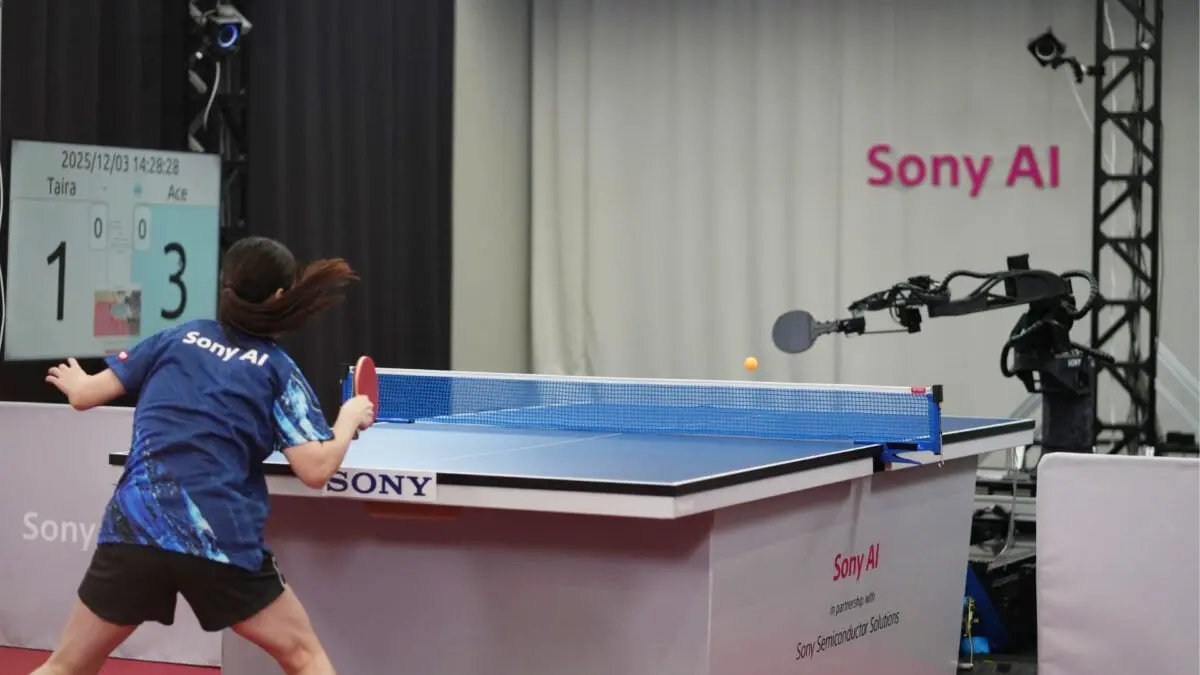
The Rise of Ace: Sony’s AI Robot Takes on Table Tennis Champions
Table tennis, a sport demanding lightning-fast reflexes, spin control, and strategic placement, has long been considered a grand challenge for robotics. Now, Sony’s AI division has unveiled a robot named Ace that can not only compete with elite human players but occasionally beat them. In a study published in the journal Nature, scientists detail how Ace won the majority of its matches against highly experienced players and even managed to upset some professionals in later tests.
The research, led by Peter Dürr at Sony AI, is a leap forward in physical artificial intelligence—systems that must perceive, decide, and act in the real world with split-second timing. Unlike simulated games where perfect information is available, table tennis requires the robot to interpret noisy sensor data, predict opponent moves, and execute precise motor commands. Ace represents years of work integrating computer vision, reinforcement learning, and advanced hardware.
Key Facts About Ace and the Study
- Robot Name: Ace (short for Autonomous Competitive Entity).
- Developer: Sony AI, the company’s dedicated artificial intelligence research division.
- Skill Level: Capable of returning high-speed, high-spin balls and executing serves that confuse even professional players.
- Match Results (April 2025): Won 3 out of 5 matches against elite players (defined as those with 10+ years of experience and 20 hours/week training). Lost both matches against pros Minami Ando and Kakeru Sone.
- Improved Performance (December 2025 & March 2026): Beat both elite and some pro players, including a win against Miyuu Kihara, ranked in the top 25 worldwide for women’s singles.
- Rules Compliance: All matches used official International Table Tennis Federation (ITTF) rules with licensed umpires.
- Publication Date: April 22, 2026 (study in Nature).
- Broader Implications: Technologies behind Ace could apply to other domains needing fast, precise human-robot interaction, such as surgery, disaster response, or entertainment.
From Pong to Pro: A Brief History of Table Tennis Robots
Robotic table tennis has been a research goal since the 1980s, with early systems using simple paddle mechanisms to hit slow, predictable shots. Over the decades, improvements in sensor technology, actuator speed, and AI-driven decision-making have gradually closed the gap between machine and human. For example, in the 2010s, researchers at the University of Tokyo built a robot that could rally with beginners, while a team at Zhejiang University created a system that could block shots but not serve or adapt to spins. What makes Ace unique is its end-to-end learning pipeline: it was trained in simulation and fine-tuned in real-world matches, allowing it to generate spin patterns that mimic human players and even invent new ones.
The Sony robot uses a combination of high-speed cameras (capturing ball position at 1,000 frames per second), force sensors on its paddle, and a real-time control system running on custom hardware. According to Dürr, the key innovation lies in the AI’s ability to estimate the ball’s trajectory and spin from incomplete visual data—a notoriously difficult problem because the ball can rotate at over 20 revolutions per second. Ace also employs a reinforcement learning algorithm that continuously improves its shot selection and footwork during each match, much like a human learning from experience.
Inside the Matches: How Ace Performed Against Humans
In the first set of experiments (April 2025), Ace faced five elite players—athletes who had dedicated over a decade to the sport. The robot lost to two of them but convincingly beat the other three. Against professional players, the challenge was greater. Minami Ando, a member of Japan’s professional table tennis league, won both matches, citing Ace’s difficulty handling very short balls and wide-angle shots. However, the robot did take one game off Ando, indicating potential.
By December 2025, the Sony team had refined Ace’s algorithm and adjusted its mechanical design—improving wrist flexibility for faster spin generation. In a rematch, Ace beat both elite and professional opponents, winning one of two professional matches. The following March, the robot achieved its biggest upset: a victory against Miyuu Kihara, a top-25 world-ranked player. During these matches, Ace demonstrated aggressive play, hitting faster shots closer to the table edges and exploiting weak spots in the opponent’s defense.
Dürr noted that the robot still struggles with extreme spins generated by top pros and with predicting deceptive body movements. But the rapid improvement cycle—from losing to elite players to beating world-ranked professionals in less than a year—is a testament to the power of AI-driven iterative learning.
Technical Challenges Overcome and Remaining
Building a robot that can play table tennis at a professional level involves solving several hard problems. First, perception: the robot must track the ball’s position, velocity, and spin in three dimensions with millisecond accuracy. Sony’s solution uses a multi-camera setup and a neural network trained on millions of simulated rallies. Second, control: the robot’s arm must move with high speed (up to 10 m/s at the paddle) and precision to intercept balls that cross the table in under 400 milliseconds. Ace uses a tendon-driven robotic arm that mimics human muscle elasticity, enabling rapid acceleration without overshooting.
Third, strategy: the robot must plan shots that maximize the chance of winning a point, considering the opponent’s likely response. This involves a hierarchy of AI modules—a high-level planner that decides whether to serve short or long, a mid-level controller that selects spin type (topspin, backspin, sidespin), and a low-level motion controller that executes the strike. All modules must operate in a closed loop within 50 milliseconds, which is about the time it takes for a human to blink.
Despite these advances, Ace is not infallible. It still lacks the capability to adapt its entire playing style mid-match as a human might. And its hardware, while impressive, is bulky and requires a dedicated power source, making it far from being ready for consumer or widespread use. The researchers stress that Ace is a research platform, not a product.
Broader Implications for AI and Robotics
The technologies developed for Ace go far beyond table tennis. The same real-time perception and control systems could be adapted for robot surgeons performing micro-operations, for autonomous drones navigating cluttered environments, or for industrial robots that need to interact safely with humans. Sony AI envisions applications in entertainment (e.g., interactive sports exhibits at theme parks) and in safety-critical domains where fast, accurate responses are essential.
Moreover, the study demonstrates that physical AI can operate reliably under the unpredictable conditions of a real sport—something that has been challenging for decades. “The results highlight the potential of physical AI agents to perform complex, real-time interactive tasks,” Dürr said. “This points to a future where robots can assist humans in dynamic environments, from emergency response to collaborative manufacturing.”
The success of Ace also raises questions about the future of competitive sports: Could robot players one day join human leagues? For now, the answer is no—the physical demands and the need for safety prevent that. But as AI robots become more dexterous, we may see specialized “robot leagues” where AI systems compete against each other, much like in e-sports.
What the Future Holds for Ace and Physical AI
While Ace probably won’t dethrone human champions like the characters in the movie Marty Supreme, the robot represents a major milestone. The Sony team plans to continue refining Ace, focusing on improving its footwork, expanding its shot repertoire, and making the system more compact. They also intend to open-source parts of the AI stack to accelerate research in the field.
Meanwhile, other robotics labs are taking notice. Competitors like Boston Dynamics and OpenAI are also exploring physical AI in sports, but table tennis remains a unique benchmark because it requires a combination of agility, precision, and strategy that few other activities can match. As Dürr put it, “Table tennis is the perfect microcosm for many challenges in robotics—perception under uncertainty, fast motor control, and strategic decision-making all in one game.”
For now, the average ping pong enthusiast need not worry about being replaced. As the article’s original writer noted, many of us are “complete trash at table tennis” anyway, so Ace can safely claim its position as the new robotic overlord of the sport—at least until the next upgrade.
Source: Gizmodo News