

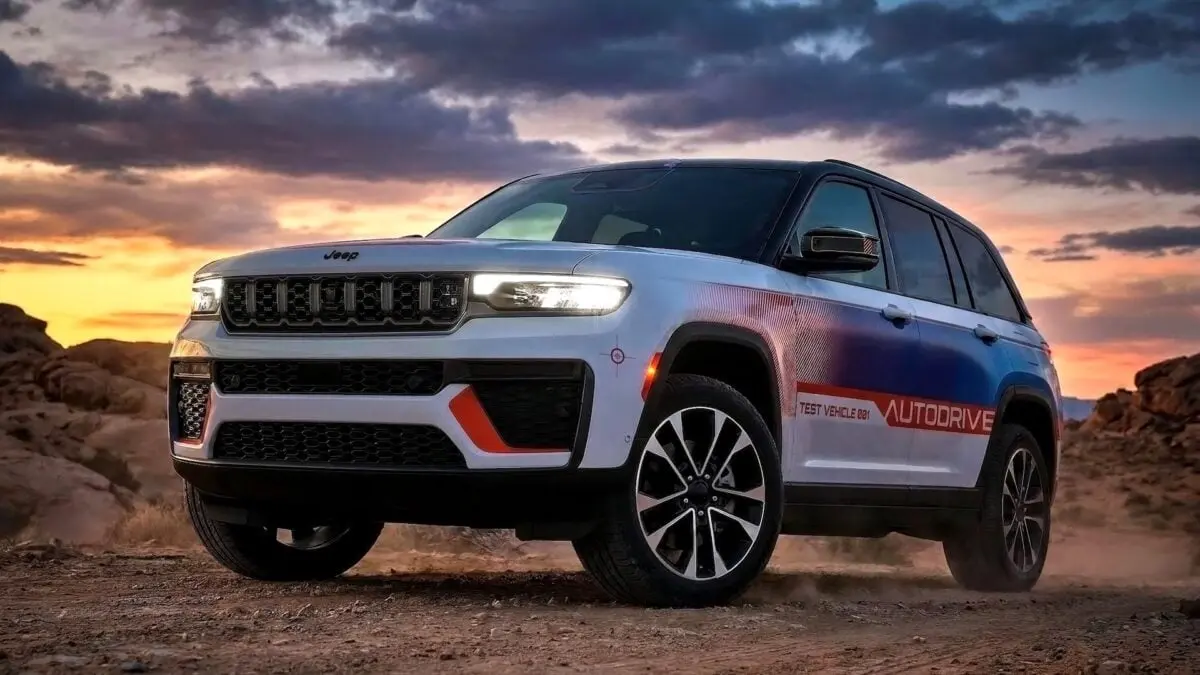
Stellantis, the multinational automotive group that owns iconic brands such as Jeep, Ram, Dodge, Fiat, Chrysler, and Peugeot, has taken a significant step toward bringing advanced autonomous driving technology to its mass-market vehicles. The company announced a new strategic technology partnership with Wayve, a London-based startup specializing in artificial intelligence for self-driving cars. This collaboration aims to integrate Wayve's AI Driver system into Stellantis' proprietary STLA AutoDrive platform, marking a major leap forward for the automaker's automated driving ambitions.
Wayve, founded in 2017 by Alex Kendall and Amar Shah, has quickly emerged as a leading player in the autonomous vehicle software space. Unlike traditional self-driving systems that rely heavily on high-definition maps and expensive sensor suites, Wayve's technology uses cameras and end-to-end machine learning to learn from real-world driving. This approach, often referred to as 'embodied AI,' allows the system to adapt to new environments without requiring constant map updates. The AI Driver is vehicle-agnostic, meaning it can be deployed across different models and platforms, including passenger cars, delivery vans, and even robotaxis.
The first fruit of the Stellantis-Wayve partnership will be a Level 2++ system, offering hands-free, supervised driving on both city streets and highways. In this classification, the driver must remain attentive and ready to take control at any moment, similar to systems already available in Tesla's 'Full Self-Driving' package or Rivian's Highway Assist. However, Wayve claims its system can handle more complex urban scenarios by learning from diverse driving data. Stellantis has confirmed that the first vehicle integration is planned for North America in 2028, with the potential to introduce higher levels of automation as regulations and customer acceptance evolve.
The partnership has already demonstrated rapid progress. Wayve developed a working prototype on the Jeep Cherokee platform in less than two months, showcasing the ease of integration. This speed is critical for Stellantis, which faces increasing pressure to compete with Tesla, Rivian, and traditional rivals like General Motors (which operates its own self-driving subsidiary Cruise) and Ford (which partners with Argo AI, though that venture was shut down). Stellantis' CEO Carlos Tavares has previously emphasized the importance of software-defined vehicles and has invested heavily in the STLA platform, which is designed to accommodate various electrified powertrains and advanced driver-assistance systems.
Wayve's technology has attracted substantial investment. In early 2026, the startup closed a $1.2 billion Series D funding round led by SoftBank, with participation from Microsoft, Nvidia, and Uber. Just last month, Advanced Micro Devices (AMD), Arm, and Qualcomm Ventures contributed an additional $60 million. Uber's investment is particularly strategic: Wayve and Uber plan to launch a robotaxi service in London in 2026, using Wayve-powered vehicles on the Uber platform. This service will mark the debut of Wayve's technology in commercial ride-hailing, providing real-world validation that could accelerate its adoption by automakers like Stellantis.
Stellantis is not alone in partnering with Wayve. Nissan announced in December 2025 that it would integrate Wayve's AI Driver into a broad range of its models starting in 2027. This deal underscores the growing trend among automakers to adopt third-party autonomous driving software rather than developing everything in-house. By leveraging Wayve's scalable, map-free approach, both Nissan and Stellantis hope to reduce development costs and speed time-to-market. For Stellantis, which has faced criticism for lagging behind in electric and autonomous vehicle technology, the partnership could be a turning point.
The auto industry is currently navigating a complex landscape for self-driving technology. While robotaxi services like Waymo (owned by Alphabet) and Cruise have expanded in select U.S. cities and in China, consumer adoption of advanced driver-assistance systems has been slower. Level 2 systems that combine adaptive cruise control with lane-keeping are common, but true hands-free highway driving and city-street navigation remain limited to a few premium vehicles. Stellantis' move to bring Level 2++ to mainstream brands like Jeep, Ram, and Dodge could democratize access to semi-autonomous driving, especially if the system proves reliable and affordable.
Wayve's AI Driver differs from competitors in its reliance on a purely vision-based approach. While Tesla also uses cameras and neural networks, Wayve emphasizes the end-to-end learning capability, where the entire driving policy is learned from data without hand-coded rules. This allows the system to generalize better to new scenarios, such as construction zones or unusual road layouts. However, critics argue that vision-based systems are vulnerable to adverse weather, lighting conditions, and sensor occlusion. Wayve has addressed these concerns by training on massive datasets collected in diverse environments, including London's narrow streets and rainy highways.
For Stellantis, the partnership aligns with its broader software strategy. The STLA AutoDrive platform is part of the STLA Brain architecture, which integrates vehicle controls, infotainment, and connectivity. By embedding Wayve's software into this platform, Stellantis can continuously improve driving capabilities via over-the-air updates, much like Tesla does. The company has also announced plans to invest €30 billion by 2025 in electric vehicles and software, highlighting the importance of these technologies to its future. The first vehicles with Wayve's system are expected to roll off assembly lines in 2028, but Stellantis has not specified which models will receive the upgrade first.
The regulatory environment will play a crucial role in the rollout. In the United States, the National Highway Traffic Safety Administration (NHTSA) has not yet established federal standards for Level 3 or Level 4 systems but allows manufacturers to deploy Level 2 systems under existing guidelines. Stellantis and Wayve have emphasized that the initial system will be supervised, meaning the driver remains legally responsible. However, they have designed the platform to be capable of higher automation levels, including Level 3 (conditional automation) where the vehicle can handle driving without human supervision in certain conditions, and Level 4 (full automation in specific areas). Stellantis has stated that it will adapt to regulatory developments and customer expectations as they evolve.
Wayve's partnerships with automakers and tech giants signal a shift in the autonomous driving industry. Instead of a one-size-fits-all approach, companies are increasingly offering flexible, software-first solutions that can be tailored to different vehicle platforms and use cases. For Stellantis, this means it can differentiate its brands: Jeep could emphasize off-road and urban autonomous capability, Ram could offer hands-free towing assistance, and Dodge could integrate performance-oriented driving modes with autonomous features. The potential applications are vast, and the partnership with Wayve provides the technological foundation to explore them.
In summary, the Stellantis-Wayve partnership represents a significant milestone in the march toward mainstream autonomous driving. By combining Stellantis' manufacturing scale and brand heritage with Wayve's cutting-edge AI software, the two companies aim to deliver a system that is safer, more adaptable, and more accessible than current offerings. With a clear timeline for North American deployment in 2028, and a strong investor backing, Wayve is positioning itself as a key player in the automotive supply chain. The coming years will test whether its vision-based, learning-driven approach can match or exceed the performance of more sensor-heavy competitors, but the early signs are promising.
Source: Gizmodo News