

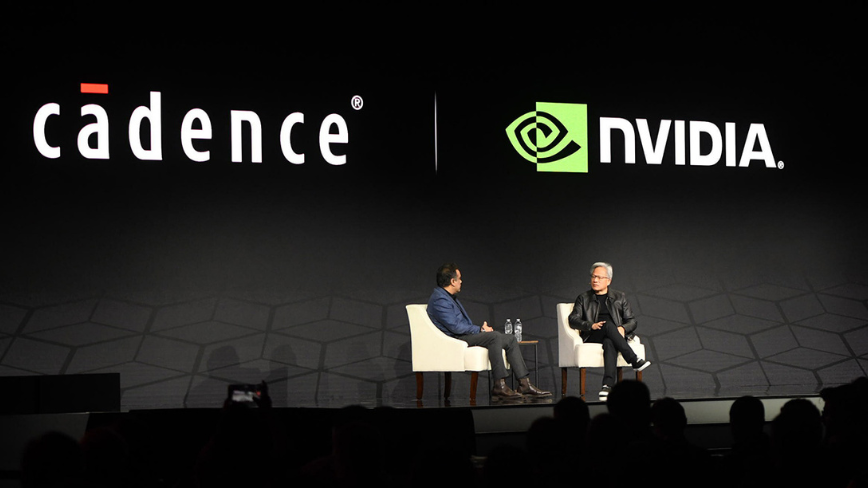
Cadence Design Systems and Nvidia have expanded their partnership to tackle a significant challenge in robotics: the disparity between robotic learning in simulations and actual performance in the physical world.
The announcement was made by the CEOs of both companies during a Cadence conference held in Santa Clara, California. The partnership focuses on integrating Cadence’s high-fidelity physics simulation engines with Nvidia’s AI training platforms, which include its Isaac open-source simulation libraries and Cosmos open-world models.
Cadence is primarily recognized as a leading provider of software for designing advanced computing chips. However, the company also develops physics engines that simulate how real-world materials interact, including the deformation of metals, fluid dynamics, and surface interactions.
These advanced simulations are traditionally utilized in sectors such as aerospace, automotive, and semiconductor design. Now, they are being adapted to create the training data necessary for robotic AI systems, enabling them to learn object handling and navigation in physical environments more effectively.
Training robots in a simulated environment is generally faster and more cost-effective than real-world training; however, the utility of this training data heavily relies on the accuracy of the physics engine used.
“The more accurate the generated training data is, the better the model will be,” stated Cadence CEO Anirudh Devgan during the conference.
Nvidia CEO Jensen Huang elaborated on the collaboration's scope, saying, “We’re working with you across the board on robotic systems.”
This partnership aims to create a comprehensive workflow that integrates Cadence’s multiphysics simulation capabilities with Nvidia’s model training pipelines, ultimately deploying the results on Nvidia’s Jetson robotics and edge AI hardware.
The resulting workflow will encompass everything from world-model training through physics simulation to real-world deployment feedback, all coordinated by AI agents throughout the entire lifecycle of the robotics systems.
This announcement aligns with Nvidia's broader strategy of forming deep simulation partnerships within industrial engineering. The company has also recently established collaborations with Siemens and Dassault Systèmes to develop industrial AI platforms and virtual twins.
For Cadence, this venture into robotics signifies a significant expansion of its simulation software into the AI infrastructure layer, particularly at a time when the demand for precise robot training data is rapidly increasing.
Source: TNW | Business News